When terrorists attacked the United States on Sept. 11, 2001, South Carolina native Frank Lee Culbertson Jr. was aboard the International Space Station — the only American off Earth.
Twenty-five years later, the retired astronaut reflects on witnessing the tragedy from orbit and how that day shaped his life.
![]()
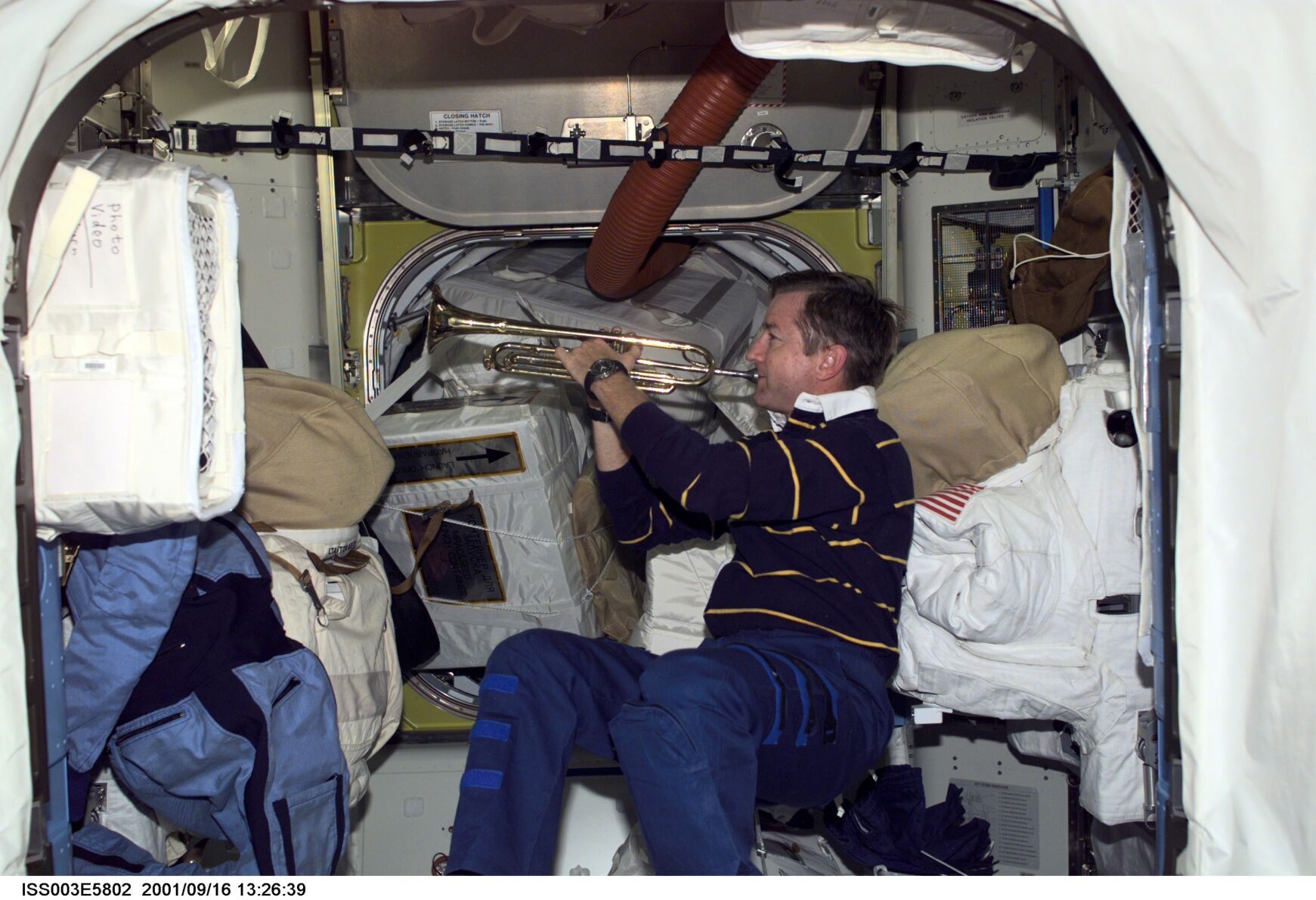
Astronaut Frank L. Culbertson Jr., Expedition Three mission
commander, takes a brief timeout from a busy day to play his
trumpet in the Quest Airlock on the International Space Station.
Culbertson played "Taps" about 10 days after the
terrorist attacks of Sept. 11, 2001.
NASA
Culbertson, then 52, was about 30 days into a four-month mission as commander of Expedition 3. He and Russian cosmonauts Mikhail Tyurin and Vladimir Dezhurov had traveled to the space station aboard the space shuttle Discovery on NASA’s STS-105 mission.
Watching tragedy from orbit
Culbertson learned about the attacks when he called flight surgeon Stephen Hart to report the results of 30-day physical exams for himself and his two crewmates, flight engineers Tyurin and Dezhurov.
“Hey, Steve, how’s it going?” Culbertson asked.
“Well, we’re not having a very good day here on Earth, Frank,” Hart replied.
![]()
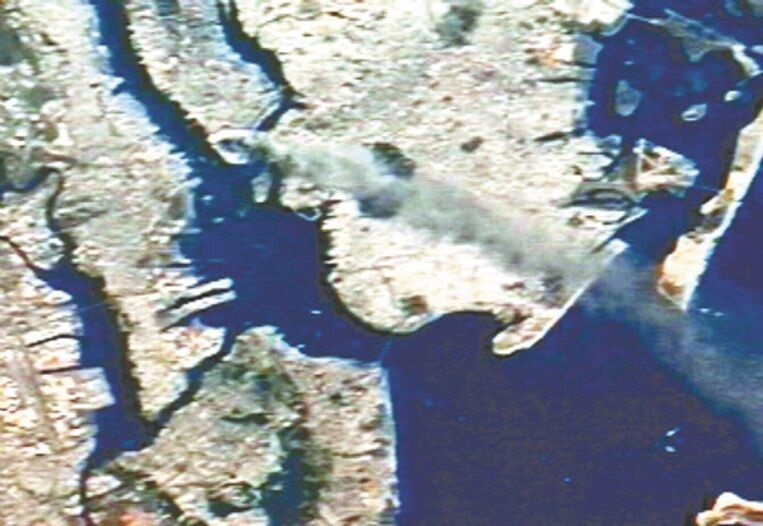
This image shows New York City following the Sept. 11, 2001
terrorist attacks from the International Space Station.
NASA
Hart told him that two planes had crashed into the World Trade Center towers.
“As he’s describing it, it sounds horrible but unreal,” Culbertson said.
The circumstances were made more surreal by what Culbertson had been reading.
![]()
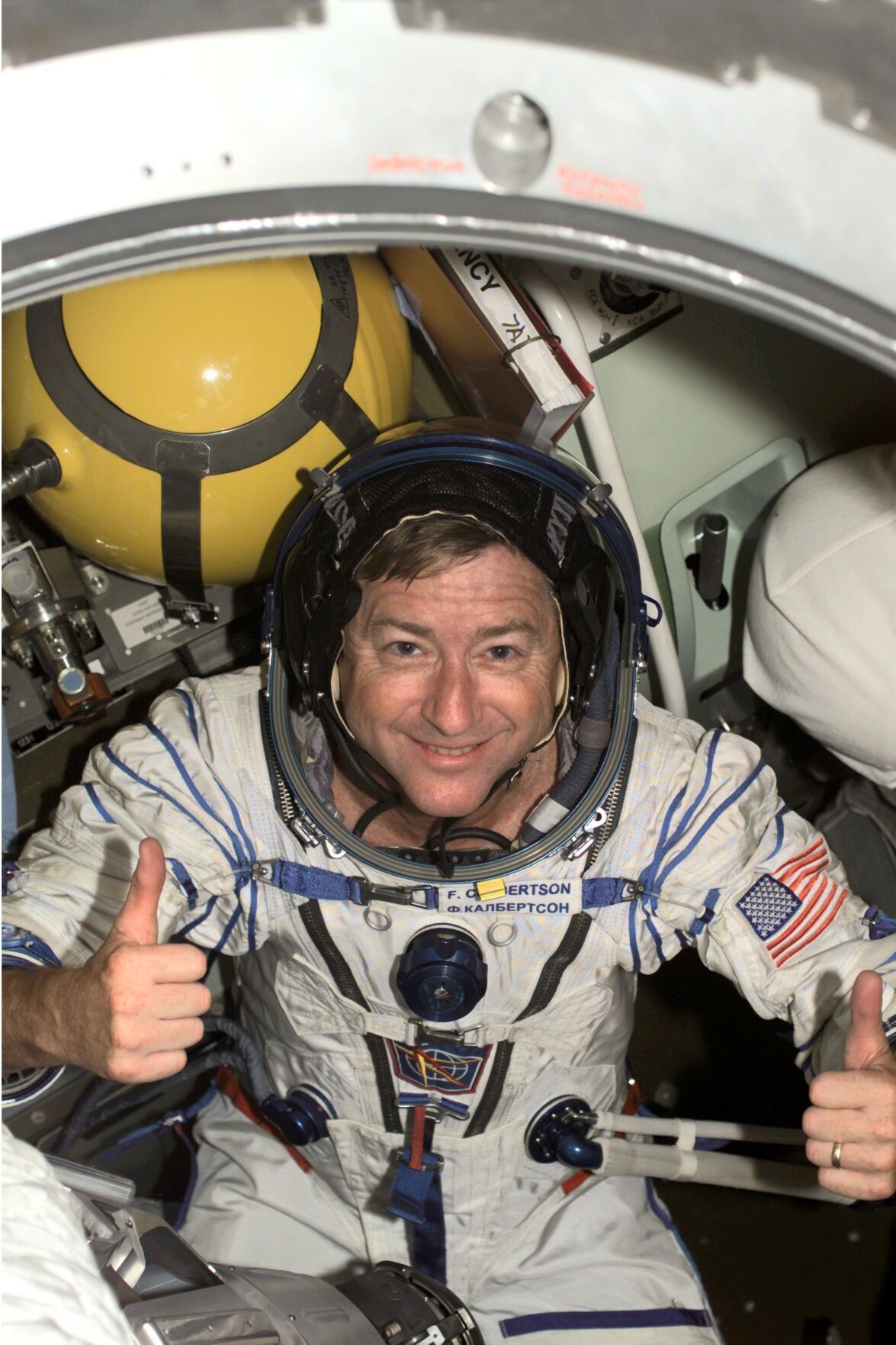
Astronaut Frank L. Culbertson Jr., Expedition Three
mission commander, wearing a Russian Sokol suit, is seated in the
Soyuz spacecraft docked to the International Space
Station.
NASA
“Coincidentally, I was actually halfway through a Tom Clancy novel, ‘The Sum of All Fears,’ which has terrorist attacks,” he said. “I felt like I was back in the novel for a minute.”
As Hart recounted the attacks, Tyurin and Dezhurov overheard the conversation and began listening.
Hart told Culbertson about the attack on the Pentagon. Then came more news.
![]()
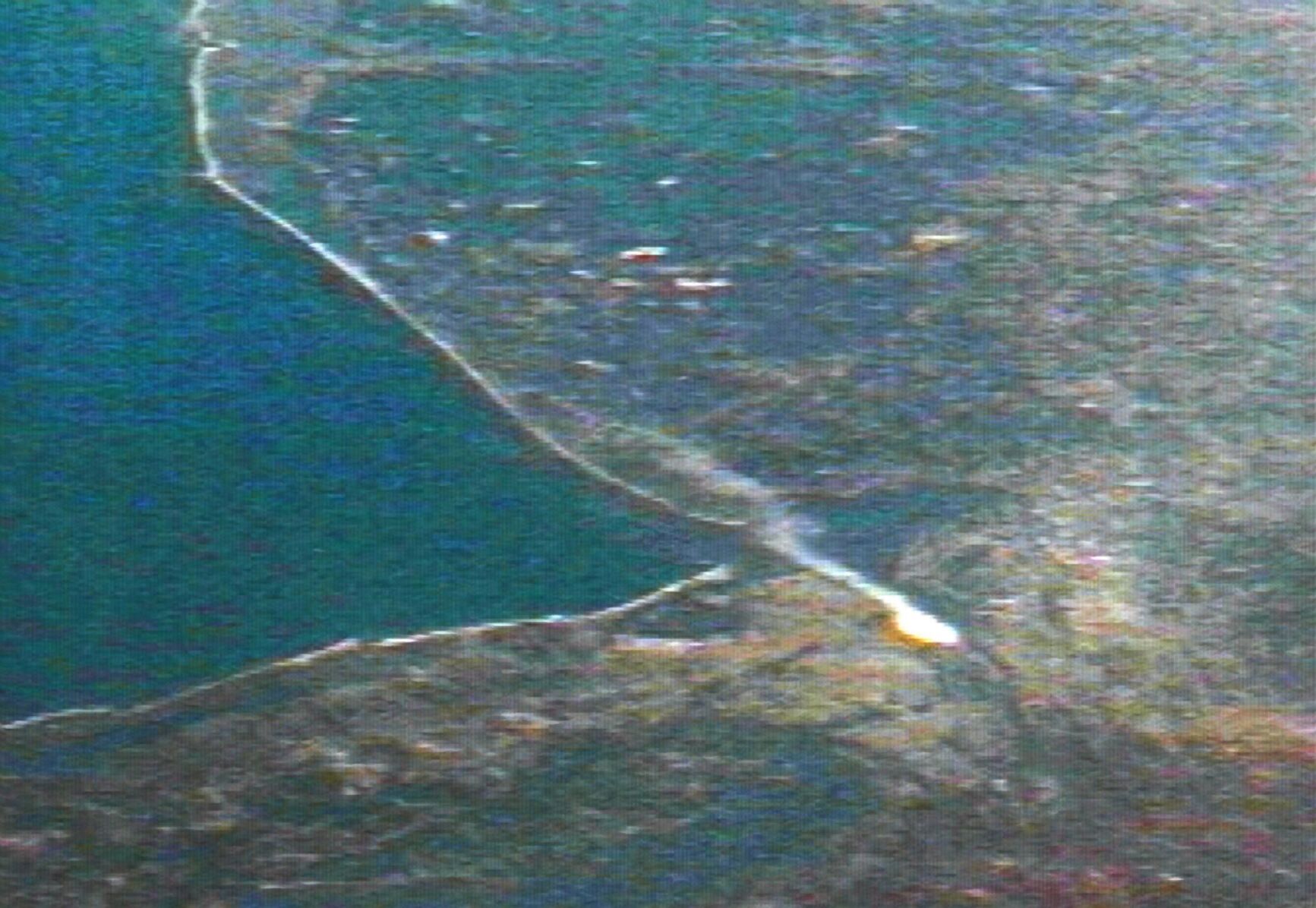
This still image, taken from video sent from the International
Space Station on Sept. 11, 2001, shows a smoke plume rising from
the Manhattan area of New York City. This view was taken by Space
Station Commander Frank Culbertson as the Space Station flew over
New York at an altitude of approximately 250 miles.
NASA
“Well, it looks like we just lost another airplane in Pennsylvania,” Hart said.
Culbertson looked at a world map that he and his crewmates kept displayed on a computer.
“I realized as we were coming across Canada, we were going to be over New England in a couple of minutes,” he said.
Frank Culbertson's footage from space and 9/11 reflections
Culbertson raced to find a video camera and a window facing in the right direction.
“From over Maine, I could zoom in on Manhattan,” he said. “It was easy to spot because you could see the big trail of black smoke going out over Long Island Sound and over the Atlantic Ocean. And as I zoomed in, this big, basically gray cloud enveloped Manhattan.”
He later learned that the cloud was caused by the collapse of the second World Trade Center tower.
They worked to get people out of the north tower as debris and bodies rained down. Then, they heard the groaning of steel.
“To me, it was horrifying, of course,” Culbertson said. “I just assumed many thousands of people were dying.”
He tried to find words appropriate for the moment.
“You don’t really know what to say in a time like that,” he said.
He made it to the 78th floor of the south tower of the World Trade Center on Sept. 11, 2001, higher than all but a few firefighters that day.
Culbertson recalled saying, “I hope we bring the people to justice who did this.”
Communications with Earth were limited that day. Security concerns also disrupted Mission Control operations, Culbertson said.
He was able to arrange a call with his family to confirm that everyone was safe, although communication remained intermittent.
“I talked to them whenever I had the opportunity to make sure they were getting through this fine,” he said.
Trumpeting ‘Taps’ from space
On Sept. 12, Culbertson learned that a friend and fellow U.S. Naval Academy classmate had been killed when hijacked American Airlines Flight 77 crashed into the Pentagon the previous day.
Charles Frank “Chic” Burlingame III, 51, was the flight’s captain.
Burlingame had been helping plan a 30-year reunion for their Naval Academy class. He and Culbertson had played trumpet together at the academy, including in a band.
“We trained together in F-4 Phantoms and knew each other well,” Culbertson said.
Unable to attend the reunion because he was in space, Culbertson already had planned to send his classmates a message from orbit.
He had taken a trumpet aboard the space station as a personal entertainment item. On the day of the reunion, Culbertson played “Taps” in honor of Burlingame and all those killed in the Sept. 11 attacks.
“I felt ‘Taps’ was appropriate because Chic and I both had played the trumpet,” Culbertson said. “It was a small thing I could do to remember the people who died.”
A friend working in Mission Control recorded Culbertson’s performance aboard the space station. The video was sent to his classmates and shown at a football game during the reunion.
25 years later: ‘Still vulnerable’
A quarter-century after the attacks, Culbertson, now 77, said the United States remains at risk.
“We’ve done a lot of things to prevent something like that happening again, but we are still vulnerable,” he said.
“The world is still a dangerous place, and there’s still a lot of people that don’t agree with us or want to take what we have or harm us,” he said. “A lot of people who are just mean.
“I think it’s important that we continue to work hard to foster peace in the world and try to reduce conflicts — not increase them.”
Culbertson also believes Americans must preserve the principles on which the nation was founded.
“I think it’s important that we maintain our own values of democracy, freedom, liberty and personal choice the way we have for 250 years,” he said.
He encouraged people to learn more about other cultures and systems of government.
“I think it’s also important that people educate themselves on why there are differences between societies and between governments and work to reduce those differences, not increase them,” he said.
‘Never gave up’
By age 11, Culbertson knew he wanted to become a pilot — but not just any pilot. He was drawn to fast planes, especially those that broke the sound barrier.
Two years later, America’s young space program expanded his ambitions.
“That’s higher, faster and further. And why not?” he recalled thinking as a teenager.
Culbertson began setting his sights on space. He read everything he could about astronauts and flying, followed the paths they had taken and worked to earn an appointment to the Naval Academy.
As a student, he paid particular attention to science and math. He credits teachers in Fairfield County public schools and at Holly Hill High School, where he spent his final two years of high school, with helping build his foundation.
While attending Holly Hill, Culbertson heard a talk by fellow South Carolinian Charles “Charlie” Bolden, then a Naval Academy midshipman. Bolden later became an astronaut and NASA administrator.
“He, even before integration, came to Holly Hill and spoke at our high school,” Culbertson said.
“He and I have been friends ever since.”
When Culbertson entered the Naval Academy as a freshman, Bolden was a senior.
“He looked out for me,” Culbertson said.
Their mothers also became close friends. Culbertson said he planned to attend Bolden’s 80th birthday celebration soon.
Reaching his goals required persistence. It took Culbertson four attempts to enter test pilot school and two attempts to secure an interview with NASA.
“But I was just determined,” he said.
Culbertson credits his family, friends and teachers with helping him along the way. He is especially grateful to his late parents, Dr. Frank and Carolina Culbertson.
“My sisters believed in my dreams, too,” he said, naming Jane, Sallie, Carolina and Amy.
His advice to students is simple.
“I never gave up,” Culbertson said. “Don’t take ‘no’ as the final answer.”
He plans to visit South Carolina more often to speak with students — encouraging them to reach for the stars, too.